Blog/The Agent Payments Stack, Live
The Agent Payments Stack, Live
Keyrock mapped 6 layers. We indexed 38 projects, scored by stack depth, and track it live.
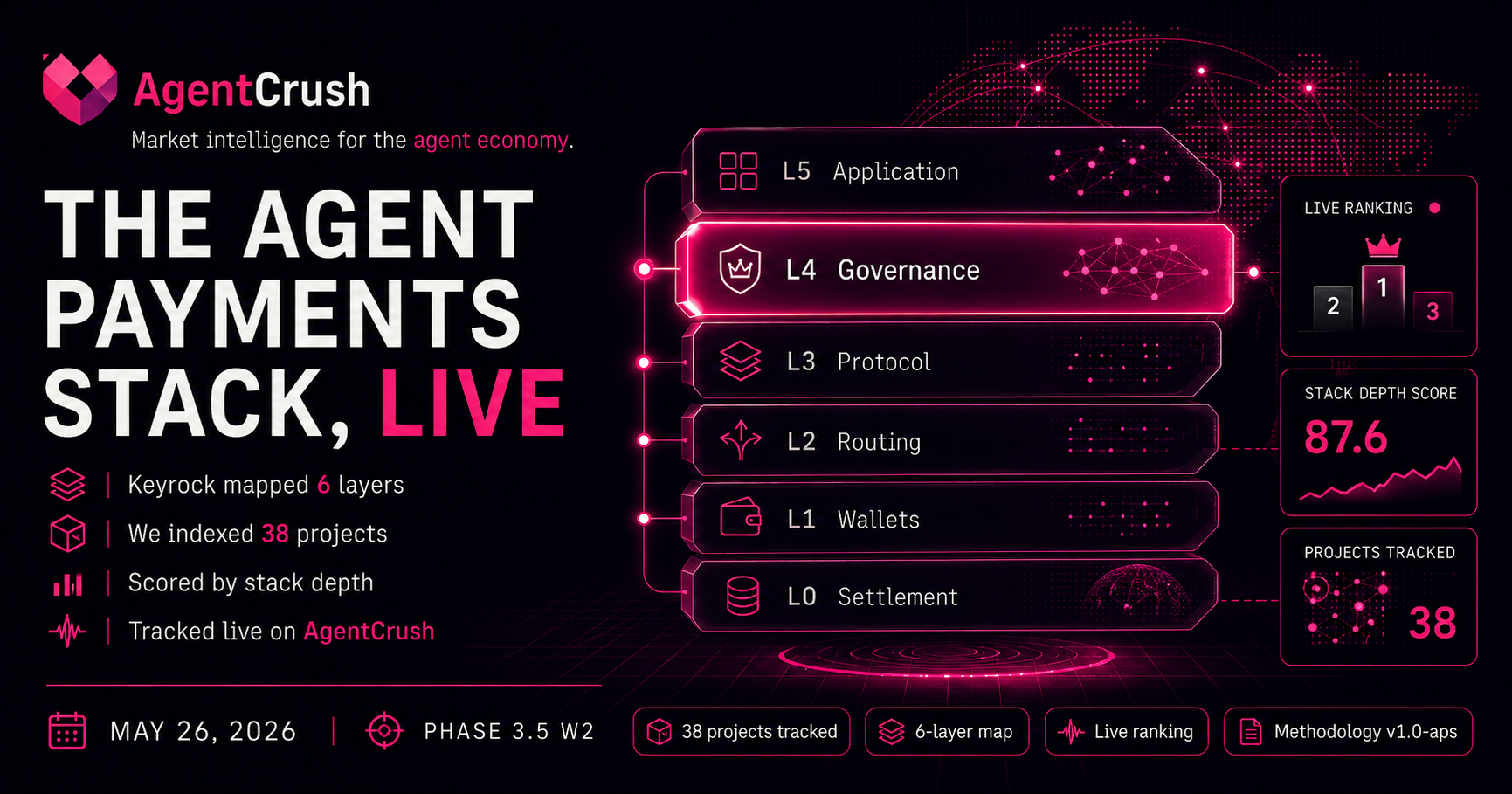
In May 2026, Keyrock published Who Pays the Agent? — a map of the infrastructure required for AI agents to transact autonomously. Six layers: settlement chains, wallets, routing, payment protocols, governance, and application frameworks.
It was the clearest framing of the payments stack we had seen. We indexed the 38 projects they identified (plus a few they didn't cover), scored each by stack depth, and wired it into the AgentCrush live index. The ranking is now live at agentcrush.xyz/rankings/agent-payments-stack.
What the 6-layer map shows
The six layers are not equal. Keyrock's thesis — which our scoring reflects — is that governance is the hardest layer to clone and therefore the most valuable. Settlement and protocol are sticky once deployed. Routing is the most commoditised.
What we found when we scored it
Coinbase spans 5/6 layers — Base (L0), AgentKit (L1), CCTP (L2), x402 (L3), AP2 partnership (L4). The only layer they don't own is Application (L5). That makes Coinbase the single hardest node to route around in the current stack. Tied with Stripe at 5 layers covered, but Stripe's coverage skews toward traditional rails rather than crypto-native protocol.
Governance is genuinely hard. Only four projects score at L4: AP2, Visa's Agentic Tokens, Mastercard's Agentic Tokens, and ERC-8004. Of these, AP2 and the card network implementations are early-stage, and ERC-8004 is crypto-native. No dominant governance standard has emerged. The project that solves governance cleanly — policy delegation, spending limits, compliance attestation, all without human intervention per transaction — has a meaningful moat.
XRPL x402 on mainnet makes three settlement chains now — Base, Solana, and XRPL all have x402 implementations live or in production. Each removes one more excuse to not wire payment into an HTTP endpoint. The real metric isn't endpoint count; it's volume routing. Which chains are agents actually transacting on?
Fetch Agent Launch is the wildcard. We added it to the tracking set because it represents a BNB-chain native path for agent deployment + payments (Fetch tokens + Agent Launch bonding curves). It's early, but it's the clearest signal that the payments stack isn't just a Base/Solana story.
What AgentCrush adds to the Keyrock map
The Keyrock report was a static snapshot. We turned it into a live index:
- All 38 projects tracked with documented evidence per layer (not self-reported).
- Stack coverage scored with published weights — no black box.
- Live updates as new projects enter the stack or existing ones expand layers.
- Machine-readable via
/api/rankings/agent-payments-stack/llm-summary— LLMs querying AgentCrush get the current ranking, not a six-week-old report.
Methodology: v1.0-aps. Source: Keyrock "Who Pays the Agent?" May 2026, extended by AgentCrush. Layer weights: L0=4, L1=3, L2=2, L3=4, L4=5, L5=3. Max score: 21.
Share